seems to be echoed on my favorite shows...
where the heck are these storylines going?

 Finding Jimm Needle in
 I missed 2003 alum Jon Joy-- Jimm's old partner in crime at Westminster. Jon was in town at the beginning of the week. Sadly, MTV called him back to L.A. for "The Hills." It's tough working in the glamorous field of television and video production. Sorry I missed you, Jon.
 Most people react to this trip to Las Vegas with envy. However, the pictures in your head may be like this....BUT WAIT....
 The panel I presented with had a decent number of people in the audience. While there were some transient visitors who left, others joined us while our program was already in progress. Half our attendees were college students.

 The Final Cut Pro Discussion Continues...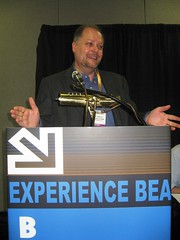

I kicked off the BEA events by attending the BEA Media Festival- News Division awards presentation.
I found it interesting that the radio feature reporting award winner was a story about favorite Christmas literature by a BYU student. While he presented solid production values, the clip played for the audience showcased clips of popular Christmas sounds and holiday sound effects and man on the street interviews. Where was the original sound from the field? The best television news feature award went to a Northwestern student and it was story slugged “Heard but not seen.” It was about a carillon at the school. That’s a story students have repeatedly covered for radio and television at
The keynote address was actually a dog and pony show presented by Apple pushing Final Cut pro. The company flew in one of its award-winning editors who uses the software and touted its use in this year’s Best Picture Oscar winner “No Country for Old Men.” While the keynote address smacked of promotions and marketing, it's clear Mac's Final Cut
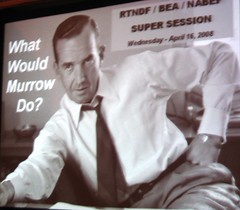 didn't really come to a consensus about anything in particular about ethics. Instead they rallied around the issue of dedicating time and resources to important journalistic coverage. They also held out hope that the convergence of media may shake out opportunities to re-discover Murrow's vision for broadcast news.
 Here's the view from our room. We're staying at Caesar's Palace this year. The Hilton doesn't capture the "glitz" of Vegas like this joint does.
While nothing is free in Vegas—not even a hotel shuttle—I’ll bump into folks who I haven’t seen in a while from academia to old newsroom pals to former students. In addition to the media advisors panel I’m presenting with on Friday, I am looking forward to a number of events including the RTNDA’s Wednesday morning panel on contemporary journalism ethics and issues entitled “What Would Ed Murrow Do?” I hope to add some additional pictures to my blog and check in through the week.
 “Living LIVE Television: Caught Between Producing & Directing”

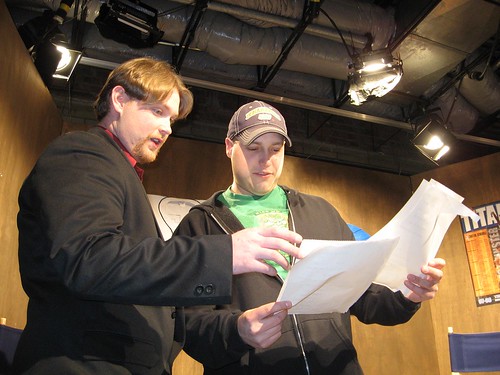 "Not So Extreme Makeover: Titantown Sports"
 "Big League Broadcasting"
 "Welcome to New Wilmington: Promoting a local community with online video storytelling"

 Deconstructing the set was a tricky process. Some of the staff at WPXI tell us it was originally installed in the 1980s and updated in various ways over the years (we saw the mauve paint under the some of the veneer). However, the news desk and key components of the central section of the set are now housed at WCN's future studio on campus as is the Fedko Fone Zone set. The staff and management at WPXI were very gracious in donating these element as the station has moved into it's new home with it's new HDTV news set. It may have been Channel 11's old set, but it will make a extremely nice news set for our efforts at Westminster College, our Broadcast Communications major and our local programming efforts on WCN.

 Gannett is gearing up for full-blown VJ model for it's Denver station. They've been toying with it under the label "BACK-PACK JOURNALIST." KUSA also has a reputation for great videographers with station and shooters there winning repeated NPPA awards.
Gannett station pushing multitaksing by staff and ad interaction by viewers, by Joanne Ostrow, Denver Post.
The changing realities of the broadcast industry are arriving at KUSA-Channel 9.
Multitasking by newsroom personnel and the push to drive viewers to interact with advertising are new priorities, according to KUSA general manager Mark Cornetta.
A recent visit to Channel 9 by Dave Lougee, the president of Gannett Broadcasting Division in McLean, Va., underscored the retooling. Lougee, the news director at KUSA from 1990 to 1996, is traveling to Gannett stations this month to trumpet what staffers call "the new normal."
"In the old world, one person shot a story, another edited it, a third told the story. In the new world, one person would be reporter/photojournalist/editor and producer for TV and the Web," Cornetta said.
Some complain about it, some love it, he said. "People are picking up a camera who never have before."
In reinventing itself as a multimedia producer for TV and the Internet, the station is "moving to a more customer-centric focus, trying to understand what advertisers look for," Cornetta said.
Accountability, namely measurement of ad "click- throughs" on the Web, is expected by today's advertisers. The station is working to accommodate advertisers by steering consumers to microsites on the Internet. An experiment, modeled after one by Dish Network, involves integrating traditional advertising with extra online content. Think of it as popup ads on TV. Nationally, cable- and satellite-TV companies are investing millions in interactive features that let viewers take more control of what they watch. A major trend is "triggers" that appear during live programming that lead to on-demand content or to interactive screens to let viewers sign up for contests, order brochures or make purchases. Regularly scheduled TV commercials are embedded with a graphic overlay, or trigger, urging viewers to leave the program they are watching to view a product or service video. Interactive TV lets advertisers know demographic information about households.


